
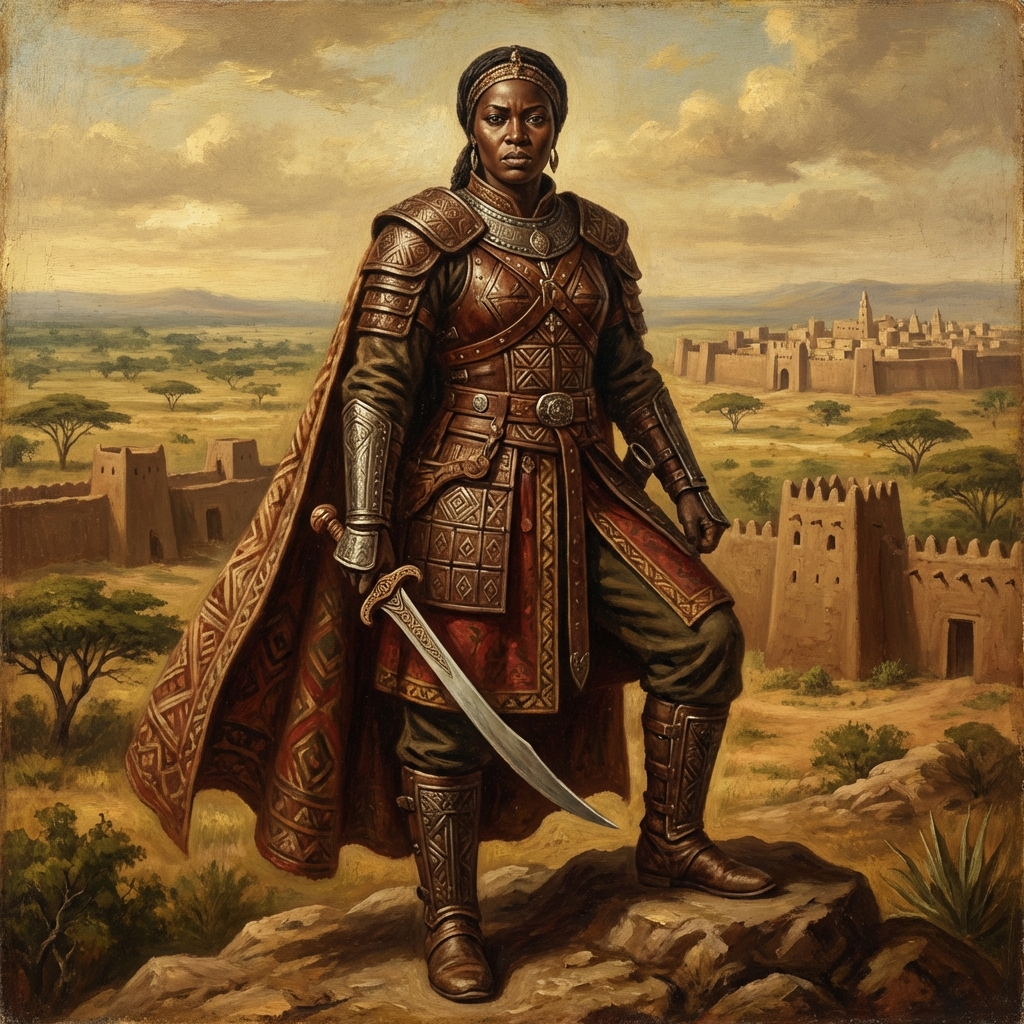
Queen Amina of Zazzau was a 16th-century Hausa warrior queen who led military campaigns that expanded the borders of Zazzau and established trade routes across West Africa. Her reign represents one of the most significant examples of female political and military leadership in pre-colonial African history. This biography is crafted through an interpretive lens that honors cultural context, symbolic power, lived experience, historical significance, and community memory.
Early Life and Ascension
Amina was born around 1533 CE in Zazzau, one of the seven original Hausa city-states (Hausa Bakwai) in what is now northwestern Nigeria. She was the eldest daughter of Queen Bakwa Turunku, who founded the city of Zaria, and King Nikatau.[1]
From an early age, Amina displayed exceptional interest in military and political affairs. According to oral traditions, she began training as a warrior at the age of sixteen, learning the arts of war alongside her brother Karama. Her grandfather, King Zazzau Nohir, recognized her talents and often allowed her to attend council meetings.[2]
"She was able well to rule, wielding the power of life and death over her people, and she fought with the men of the north and subdued them." — Kano Chronicle
Reign and Military Campaigns
Amina ascended to the throne in 1576 CE following the death of her brother Karama. She inherited a prosperous kingdom but faced threats from neighboring states seeking to control the lucrative trans-Saharan trade routes that passed through Hausa territory.
Her military campaigns are legendary in West African history. Within the first three months of her reign, she led her army of 20,000 soldiers into battle. Over the next 34 years, she conducted continuous warfare, expanding Zazzau's territory to its largest historical extent.[3]
The Amina Walls
Perhaps her most enduring architectural legacy is the network of fortified walls she constructed around conquered cities. Known as "ganuwar Amina" (Amina's walls), these defensive structures can still be seen today in various Nigerian cities including Kano, Katsina, and Zaria. These walls represent some of the earliest examples of urban fortification in West Africa.[4]
Trade and Economic Influence
Beyond military conquest, Amina demonstrated sophisticated understanding of economic power. She established and protected trade routes that connected Zazzau to the broader trans-Saharan trade network, bringing wealth through the exchange of leather goods, cloth, kola nuts, salt, and enslaved peoples with North African merchants.
Her conquests opened new markets and secured access to valuable resources, particularly iron deposits that were essential for weapons production. This economic foundation strengthened Zazzau's position among the Hausa states for generations after her death.
Symbolic Power and Legacy
Queen Amina's legacy transcends her military achievements. She represents a powerful symbol of female leadership in a context where women's political authority was exceptional. Oral traditions emphasize not only her military prowess but also her wisdom in governance and her commitment to never marrying, maintaining her independence and focus on statecraft.[5]
Her story has inspired numerous cultural productions, including a 2000 Nigerian film and various literary works. In 2020, the African Union named her among the 100 greatest Africans of all time.
Death and Commemoration
Queen Amina died around 1610 CE in Atagara during one of her military campaigns. She was buried with full military honors, and her legacy was preserved through generations of oral tradition before being recorded by colonial-era historians and anthropologists.
Today, she is commemorated through the Queen Amina of Zaria statue in Lagos, and her likeness appears on various Nigerian cultural materials. The Amina Barracks in Kaduna is named in her honor.